Philips Avent DECT Baby Monitor SCD503/26 Review: Crystal Clear Sound, 100% Private.
The Philips Avent DECT Baby Monitor SCD503/26 promises something that many modern baby monitors fail to deliver – a truly private, interference-free connection that just works. No WiFi and apps to download or monthly subscription fees. Just reliable, crystal clear audio straight from your baby’s room to your hands.
But is this audio-only monitor really worth buying in 2025? And is it the right choice for your family? In this honest, in-depth review, we cover every feature, the real-world performance, what parents actually say about it, and exactly who it suits – and who it doesn’t.
What Is the Philips Avent DECT Baby Monitor SCD503/26? (Quick Overview)
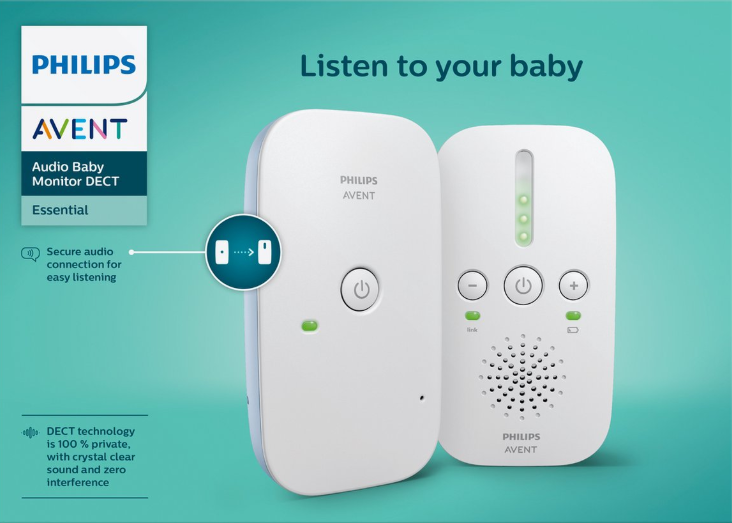
The Philips Avent SCD503/26 is an audio-only baby monitor. It uses DECT – Digital Enhanced Cordless Telecommunications – technology to send a private, secure audio signal from the baby unit in the nursery to the handheld parent unit. There is no camera, no screen, and no internet connection involved.
Philips launched this model in 2022 as part of its Essential Audio range. It sits above the bare-bones SCD501 entry model but below the more feature-rich SCD560. So it hits a sweet spot – essential features, trusted brand quality, and an accessible price.
The Philips Avent Audio Baby Monitor SCD503/26 includes Smart ECO mode for automatic battery saving, a 5-LED sound-level display, a soothing nightlight on the baby unit, out-of-range alerts, and a parent unit that works on both mains and AA batteries. It covers up to 50m indoors and up to 330m outdoors.
It comes backed by a 2-year manufacturer warranty – which is solid reassurance from a globally recognised brand.
➡️ Check the Latest Price of the Philips Avent SCD503/26 on Amazon →
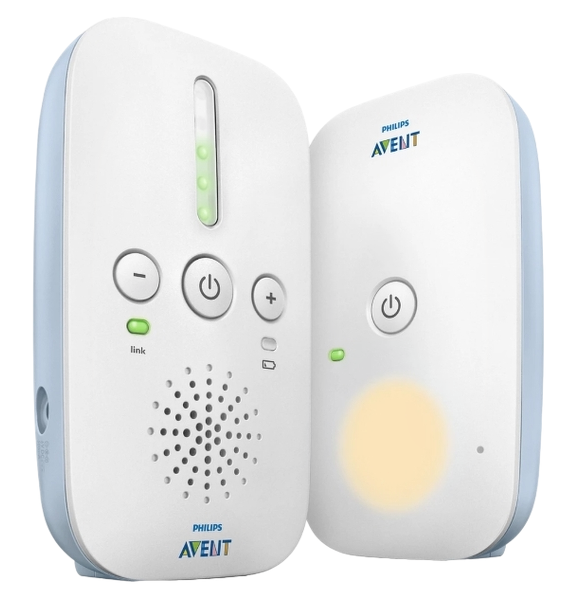
Philips Avent DECT Audio Baby Monitor SCD503/26
Philips Avent SCD503/26 – Full Specifications at a Glance
| Feature | Details |
|---|---|
| Connection Type | DECT (Digital Enhanced Cordless Telecommunications) |
| Indoor Range | Up to 50 m |
| Outdoor Range | Up to 330 m |
| Battery / Standby | Up to 24 hours (parent unit) |
| Smart ECO Mode | Yes – automatic energy saving |
| Night Light | Yes (on baby unit) |
| Two-Way Audio | No |
| Sound Activation | Yes – 5 LED indicator lights |
| Temperature Display | No |
| Lullabies | No |
| WiFi Required | No |
| Expandable | No |
| Number of Channels | 120 (automatic channel selection) |
| Power Source | AC mains + 2× AA batteries (parent unit) |
| Parent Unit Dimensions | 11 × 10 × 4 cm |
| Product Weight | 164 g |
| Colour | White |
| Warranty | 2 years |
| In the Box | Parent unit, baby unit, connection cable, manual, quick start guide |
| Introduced | 2022 |
Key Features of the Philips Avent DECT Baby Monitor SCD503/26
So what exactly do you get with the Philips SCD503/26 Baby Monitor? Let’s break down each feature in plain, simple language – so you know precisely what this monitor does and doesn’t offer.
1. 100% Private DECT Connection – Your Baby’s Audio Stays Yours
DECT stands for Digital Enhanced Cordless Telecommunications. It’s the same proven technology used in millions of cordless home telephones around the world. And it’s been around – reliably – since 1993.
So why does it matter for a baby monitor? Because DECT delivers something that analogue 2.4GHz monitors and WiFi-connected cameras simply can’t match: a completely private, encrypted digital signal.
Here’s what that means for you as a parent:
- ✅ Zero interference from other baby monitors, cordless phones, or mobile devices nearby
- ✅ No remote hacking risk – there’s no internet connection involved, so there’s nothing for hackers to target
- ✅ No WiFi password required – the two units connect directly to each other
- ✅ No app, no account, no subscription – ever
- ✅ 120 automatic channels – the monitor self-selects the clearest available frequency
This is especially valuable if you live in a flat, apartment block, or housing estate where many families are using wireless devices at the same time. Traditional 2.4GHz monitors frequently pick up interference from neighbours’ devices. But the Philips Avent SCD503/26 DECT Baby Monitor locks onto its own private, encrypted channel – and stays there.
For parents who worry about digital privacy, this is the single biggest reason to choose the SCD503/26 over a WiFi-connected video monitor.
2. Crystal Clear Sound – Hear Every Murmur, Giggle and Cry
DECT doesn’t just protect your privacy – it also delivers noticeably better audio than most analogue baby monitors. The digital signal stays clean and stable, so what you hear on the parent unit accurately reflects what’s actually happening in the nursery.
The Philips Avent Audio Baby Monitor SCD503/26 picks up soft sounds – a gentle murmur, a quiet rustle, a tiny hiccup – and transmits them clearly. You don’t have to turn the volume to maximum just to hear your baby breathe.
The parent unit includes a volume control button and adjustable sound sensitivity. So you can tune it to your environment – quieter if you’re in a silent bedroom, more responsive if you’re in a busy kitchen. This flexibility makes it practical throughout the day and night.
Honest note: Some users report that even at maximum volume, the parent unit can feel a little quiet compared to certain competitors. It’s not dramatically low – but if you’re a very heavy sleeper, you may want to keep the parent unit close to your bed rather than across the room.
3. Smart ECO Mode – The Battery-Saving Feature That Works for You
This is one of the Philips SCD503/26’s standout features – and one that many parents don’t fully appreciate until they start using it.
Smart ECO Mode automatically reduces the audio transmission power when the nursery is quiet. When your baby is sleeping peacefully and making no sound, the monitor drops its transmission to a lower power state – saving battery life on the parent unit and reducing unnecessary wireless transmission.
As soon as a sound occurs – a cry, a movement, a murmur – the monitor instantly returns to full power and delivers the sound to the parent unit. You don’t miss a thing.
There’s another clever layer to ECO mode, too. The closer the parent unit is to the baby unit, the less power is required to maintain a perfect connection. So if you’re sitting in the next room, the monitor automatically uses less energy than if you were at the far end of the garden. It’s genuinely intelligent energy management.
In practice, this extends battery life significantly during overnight monitoring when the baby sleeps for long stretches. But here’s the honest caveat: the stated 24-hour battery life is a best-case figure. Real-world battery life depends on:
- The type of AA batteries you use (rechargeable vs. alkaline)
- How active ECO mode is (more noise = more active transmission = shorter battery)
- The distance between parent and baby unit
For best results, use the parent unit on mains power overnight and switch to batteries during the day when you’re moving around the house.
4. 5 LED Sound-Activation Lights – Visual Monitoring When You Need It
The Philips Avent SCD503/26 includes a row of five LED indicator lights on the parent unit. These lights activate in proportion to the noise level in the baby’s room – even if the parent unit volume is turned all the way down or muted.
Why does this matter? Because there are plenty of situations where you can’t have audio playing out loud:
- During a work-from-home video call
- When you’re watching TV with a partner at night
- During a quiet moment with guests
- When you need to focus without background noise
In all of these situations, a quick glance at the LED bar tells you instantly whether the nursery is quiet or whether something needs your attention. The more LEDs lit up, the louder the noise. It’s a beautifully simple visual alert system that doesn’t require you to watch a screen or check a phone.
And because the Philips SCD503/26 has no screen at all – only this LED bar and the audio – the parent unit itself stays simple, lightweight and easy to carry.
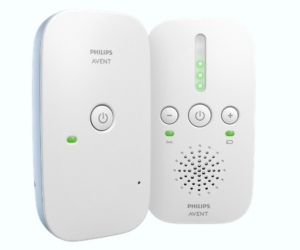
Philips Avent DECT Baby Monitor SCD503/26
✔ 100% private DECT – zero interference
✔ Smart ECO mode – up to 24-hr battery
✔ 330m range
✔ soothing nightlight
5. Up to 330m Outdoor Range – Freedom to Move
Philips states the Philips Avent DECT Baby Monitor SCD503/26 delivers an indoor range of up to 50 metres and an outdoor range of up to 330 metres. That’s a generous range for a baby monitor in this price bracket.
In practice, the effective indoor range depends heavily on your home’s construction. Thick stone or brick walls, concrete floors, and metal structures all reduce the signal. But in a standard modern house or flat, most parents find the signal holds well throughout the entire property – including the kitchen, bathroom, garden, and garage.
Independent testers have walked through multi-floor apartments and changed levels without losing connection. And in obstacle tests – with multiple electronic devices placed next to both units – the DECT signal remained clean and clear throughout.
Honest note: If you live in an older home with very thick stone walls, or in a large multi-storey house, you may find the effective indoor range shorter than 50m. Positioning both units on the same floor when possible will help maintain the strongest connection.
6. Soothing Nightlight on the Baby Unit
One of the most underappreciated features of the Philips Avent SCD503/26 is the built-in nightlight on the baby unit. It emits a warm, gentle glow – enough to softly illuminate the nursery without being harsh or bright enough to fully wake a sleeping baby.
The nightlight helps in a few practical ways:
- Settling a restless baby – the soft light provides comfort and orientation when your baby first wakes
- Night feeds and checks – when you go into the room at night, the gentle glow means you don’t need to switch on a main light and fully disturb your baby
- Toddler comfort – as your child gets older, a nightlight becomes a reassuring presence at bedtime
You activate the nightlight with the button on the baby unit itself. There’s no remote control from the parent unit – so you need to press it manually when putting baby down. But once it’s on, it provides a steady, calming light throughout the night.
7. Out-of-Range and Low Battery Alerts – You’re Always Informed
The Philips Avent SCD503/26 DECT Baby Monitor includes two practical safety alerts built into the parent unit:
- Out-of-range alert: If you walk too far from the baby unit and the connection weakens, the parent unit alerts you with a sound. So you always know if you’ve moved outside reliable monitoring range – rather than discovering later that you missed something.
- Low battery alert: The parent unit alerts you when the battery is running low, so you can plug in or swap batteries before the unit dies during a monitoring session.
These two alerts are simple – but they matter a great deal in practice. They turn the monitor from a passive listening device into a system that actively keeps you informed about its own status. That’s exactly what a tired parent needs.
8. Works on Both Mains and Battery Power
The Philips Avent SCD503/26 gives the parent unit a dual power option – mains or battery – so you can use it however suits your day.
- Mains power: Plug in the parent unit for all-night, worry-free monitoring beside your bed. Also ideal when you’re settled at a desk or on the sofa.
- Battery power: Insert two AA batteries to go portable – carry the parent unit around the house, into the garden, or anywhere within range.
Compatible battery types: two 1.5V R6 AA alkaline non-rechargeable batteries, or two 1.2V R6 AA NiMH rechargeable batteries. The baby unit (transmitter), however, must remain plugged into the mains at all times – it has no battery option.
This dual-power setup is one of the most practical aspects of the SCD503/26. It means you’re not locked into either always being plugged in or always relying on batteries. You use whichever option fits the moment.
9. Compact, Lightweight and Simple Design
The Philips SCD503/26 measures just 11 × 10 × 4 cm and weighs 164g – lighter than most smartphones. It fits comfortably in one hand and slips easily into a pocket or a changing bag.
The design itself is clean and minimalist – white plastic, rounded corners, smooth surfaces. There are very few buttons: a power button, a volume button, and the controls for the nightlight on the baby unit. That’s it. Fewer controls means less confusion – and that’s a real advantage at 3am when you’re half-asleep.
Philips has built both units with a sturdy, quality feel. The rounded corners and smooth casing also mean the device is safe to have around a curious toddler – no sharp edges or protruding parts to cause harm.
Philips Avent DECT Baby Monitor SCD503/26 – Pros and Cons
✅ Pros of the Philips Avent SCD503/26
- 100% private DECT connection – zero interference, zero WiFi hacking risk
- Crystal clear digital audio – clean, stable sound transmission
- Smart ECO mode – automatic battery saving when the nursery is quiet
- Up to 24 hours battery life on the parent unit
- 330m outdoor / 50m indoor range
- 5 LED sound-level lights – visual monitoring even on mute
- Soothing built-in nightlight on the baby unit
- Out-of-range and low battery alerts – always informed
- Mains and battery operation – flexible use throughout the day
- Minimal, intuitive controls – no learning curve
- Compact and lightweight – 164g and pocket-sized
- No WiFi, no app, no subscription required
- 2-year manufacturer warranty
- Trusted Philips Avent brand with global reputation
❌ Cons of the Philips Avent SCD503/26
- Audio-only – no camera, no video, no screen
- No two-way audio – you can hear the baby but cannot speak back
- No temperature sensor or display
- No lullabies or remote soothing sounds
- Not expandable – cannot add a second camera or handset
- Baby unit is mains-only – must stay plugged in at all times
- Volume can feel low at maximum for some users
- Effective indoor range may be shorter in thick-walled buildings
- Nightlight cannot be controlled from the parent unit remotely
- No recording function
Real User Reviews – What Parents Say About the Philips Avent DECT Baby Monitor SCD503/26
What Parents Love About Philips Avent DECT Baby Monitor?
Across review platforms, the most consistent praise for the Philips Avent SCD503/26 focuses on three things: simplicity, reliability, and the peace of mind that comes with a private, non-WiFi connection.
Parents repeatedly describe the setup as taking just a few minutes – no frustrating app configuration, no network passwords, no technical knowledge required. You plug it in, switch it on, and it works. That simplicity is especially valued by first-time parents who are already navigating a steep learning curve with a newborn.
The DECT connection earns consistent trust from parents who have previously used analogue baby monitors and experienced interference or dropped signals. Many describe the SCD503/26 as noticeably more stable and reliable than previous monitors they’ve owned. Parents who live in blocks of flats particularly appreciate the interference-free performance, where 2.4GHz monitors often pick up noise from neighbouring devices.
The compact size of the parent unit is another point of praise. Parents appreciate being able to carry it in a dressing gown pocket during night-time checks, clip it near the kitchen worktop, or place it on a bedside table without it taking up much space.
Common Criticisms from Users
The most repeated criticism is the volume level. Some parents, particularly heavier sleepers, report that even at maximum volume the parent unit doesn’t feel loud enough. This is more noticeable in noisy environments – a busy kitchen, a room with background music, or if you keep the unit across the room rather than close to your bed.
A smaller but consistent complaint relates to indoor range in older properties. The 50m indoor range is achievable in open-plan modern homes, but parents in older houses with thick stone or brick walls sometimes experience signal drops when moving between floors or to rooms far from the nursery.
And the biggest single limitation that some buyers only realise after purchasing: there is no camera. Parents who expected a visual element – or who later decide they want one – feel the SCD503/26 is too basic. This isn’t a flaw in the monitor itself, but it’s worth being completely clear about before you buy.
Expert Testing Summary
Independent testing consistently confirms that the Philips Avent DECT Baby Monitor SCD503/26 performs well in its core function – delivering a stable, interference-free audio connection across a multi-room home.
Testers who walked through entire apartments, changed floors, and deliberately introduced interference from mobile phones and televisions found that the DECT connection remained clean and stable throughout. The sound quality held up without distortion or breakup.
The Smart ECO mode was confirmed to work as described – the monitor went silent when the nursery was quiet and responded quickly when sounds occurred. The 5 LED lights provided accurate, useful visual feedback. And the nightlight was rated as a genuinely practical, well-calibrated addition – soft enough not to disturb sleep, but bright enough to be useful.
Overall, expert assessors consistently describe the SCD503/26 as exactly what it claims to be: a simple, well-built, privacy-focused audio baby monitor that does its core job reliably.
Philips Avent DECT Baby Monitor SCD503/26
✔ 100% private DECT – zero interference
✔ Smart ECO mode – up to 24-hr battery
✔ 330m range
✔ soothing nightlight
Philips Avent SCD503/26 vs. Competitors – How Does It Stack Up?
Philips Avent SCD503/26 vs. Philips Avent SCD501 (Entry Level)
The SCD501 is Philips’s most basic audio monitor. It lacks rechargeable battery support, has no adjustable sound sensitivity, and offers only the most minimal feature set. The SCD503/26 adds Smart ECO mode, adjustable volume sensitivity, a nightlight, and battery-compatible parent unit – all for a modest price increase. For most parents, the SCD503/26 represents significantly better value.
Philips Avent SCD503/26 vs. Philips Avent SCD560 (Mid-Range)
The SCD560 sits above the SCD503/26 and adds two-way audio (intercom) and a room temperature sensor with display. If you want to speak to your baby through the monitor or see the nursery temperature, the SCD560 is the next step up. But if audio-only monitoring is enough for you, the SCD503/26 saves you money without sacrificing the core DECT technology.
Philips Avent SCD503/26 vs. VTech VM819 (Video Monitor)
The VTech VM819 is a non-WiFi video baby monitor at a similar price point. It adds a 2.8″ screen, night vision camera, five lullabies, a temperature sensor, and two-way audio – all things the SCD503/26 doesn’t offer. But the VTech uses FHSS wireless technology rather than DECT. DECT generally delivers a more reliable, interference-resistant signal. So if video is important to you, the VTech is the better choice. But if crystal clear audio and maximum privacy are your priorities, the Philips Avent Audio Baby Monitor SCD503/26 holds its own.
Quick Comparison Table
| Monitor | Type | WiFi | Two-Way | Temp Sensor | Nightlight | Range |
|---|---|---|---|---|---|---|
| Philips SCD503/26 | Audio | No | No | No | Yes | 330m |
| Philips SCD560 | Audio | No | Yes | Yes | Yes | 330m |
| Philips SCD501 | Audio | No | No | No | No | 330m |
| VTech VM819 | Video + Audio | No | Yes | Yes | No | 300m |
Who Should Buy the Philips Avent DECT Baby Monitor SCD503/26?
This Monitor Is Perfect For…
- Privacy-conscious parents who don’t want a WiFi-connected camera in the nursery
- First-time parents who want a simple, reliable monitor without a technology learning curve
- Parents in flats or apartments where wireless interference from neighbouring devices is a real problem
- Tech-averse families – grandparents, caregivers – who need something intuitive with minimal controls
- Budget-conscious buyers who want a trusted brand name without paying a premium price
- Parents who are comfortable checking on their baby in person and need an audio alert system rather than a visual one
- Families who value simplicity over features – no lullabies, no temperature sensor, just reliable monitoring
You May Want to Look Elsewhere If…
- You need to see your baby – a video monitor is essential for you
- You want to talk to or soothe your baby remotely via two-way audio
- You need a temperature sensor to monitor nursery conditions
- You want built-in lullabies to calm your baby remotely
- You need to monitor two rooms at once – this monitor is not expandable
- You want remote app access to check on your baby from outside the home
How to Set Up the Philips Avent DECT Baby Monitor SCD503/26 – Step-by-Step Guide
Philips Avent DECT Baby Monitor – What’s in the Box
Philips Avent DECT Audio Baby Monitor SCD503/26 box
- 1 × Parent unit (receiver)
- 1 × Baby unit (transmitter)
- 1 × Connection cable
- 1 × User manual
- 1 × Quick start guide
Step 1 – Place and Plug In the Baby Unit
Position the baby unit in the nursery – on a shelf or surface near (but not in) the crib. Connect it to a mains socket using the included cable. The baby unit must remain plugged in at all times because it has no battery of its own.
Step 2 – Power On the Baby Unit
Press the power button on the baby unit. The unit activates and immediately begins transmitting. You can also activate the nightlight at this stage by pressing the nightlight button on the baby unit.
Step 3 – Prepare the Parent Unit
Insert two AA batteries into the parent unit for portable use – or connect it to a mains socket if you prefer to keep it plugged in. Then press the power button on the parent unit.
Step 4 – Wait for Automatic Pairing
The Philips Avent SCD503/26 comes pre-paired from the factory. Both units should connect automatically within a few seconds of being powered on. The indicator light on the parent unit confirms a successful connection. No manual pairing process is needed for first-time use.
Step 5 – Adjust Volume and Sound Sensitivity
Use the volume control button on the parent unit to set your preferred listening level. Adjust the sound sensitivity threshold so the monitor responds to meaningful sounds – your baby’s cry or movement – without being triggered by every ambient noise in the background.
Step 6 – Enable Smart ECO Mode
Smart ECO Mode is active by default. There’s nothing to switch on – the monitor automatically manages its own transmission power based on the sound level in the nursery and the distance between the two units.
Step 7 – Test Your Range
Walk through every room in your home – and outside if relevant – to confirm the connection remains solid. Listen for the out-of-range alert. This tells you exactly how far you can roam with confidence during your baby’s nap or overnight sleep.
That’s the full setup – done in under five minutes.
Tips for Getting the Most Out of Your Philips Avent DECT Baby Monitor SCD503/26
- Plug the parent unit into mains at night. Battery life is generous, but overnight monitoring is long. Mains power overnight means you wake up with a fully charged parent unit for the day ahead.
- Use AA batteries during the day. Switch to battery power when you’re moving around the house, garden, or garage. This is where the portability of the parent unit really earns its value.
- Keep both units on the same floor if possible. Concrete ceilings and floors significantly reduce the effective indoor range. Same-floor placement gives you the strongest, most reliable connection.
- Adjust sound sensitivity in a quiet room. Set the sensitivity threshold during a quiet period – not during background noise – so the calibration is accurate. This prevents false alerts and saves battery life.
- Let ECO mode work for you. Don’t disable ECO mode unless you have a specific reason. It intelligently manages power based on real conditions, and leaving it on will meaningfully extend your battery use between charges.
- Use the LED lights when you need to mute audio. During calls, meetings, or quiet evenings with guests, mute the audio and rely on the 5-LED sound-level display. A quick glance tells you everything you need to know about the nursery without interrupting your conversation.
- Position the baby unit above floor level. Place the baby unit on a shelf or bracket at least 1 metre above the floor. Higher placement means the signal travels more freely through the room and picks up sound more evenly.
Philips Avent DECT Baby Monitor SCD503/26
✔ 100% private DECT – zero interference
✔ Smart ECO mode – up to 24-hr battery
✔ 330m range
✔ soothing nightlight
Philips Avent DECT Baby Monitor SCD503/26 – Frequently Asked Questions (FAQ)
The Philips Avent DECT Baby Monitor SCD503/26 has a stated indoor range of up to 50 metres and an outdoor range of up to 330 metres. These are maximum figures in ideal open conditions. In real homes – with walls, floors, furniture, and appliances – the effective indoor range will typically be less than 50 metres. In a standard modern house or flat, most parents find the connection holds reliably throughout the entire property.
No – the Philips Avent SCD503/26 does not require WiFi at all. It uses DECT wireless technology to create a direct, secure connection between the baby unit and the parent unit. No internet connection, no router, no app, and no account is needed. This makes it one of the most private and secure audio baby monitors available today.
The Philips Avent DECT Baby Monitor SCD503/26 is extremely difficult to intercept or hack. Because it uses DECT technology – a digitally encrypted wireless standard – and does not connect to the internet at any point, it cannot be accessed remotely by third parties. DECT operates across 120 automatic channels with built-in digital encryption, making unauthorised eavesdropping highly unlikely in any real-world scenario.
No – the Philips Avent SCD503/26 is a one-way audio monitor only. You can hear your baby clearly through the parent unit, but you cannot speak back through the monitor to your baby. If two-way audio is important to you, consider the Philips Avent SCD560, which includes full intercom/two-way communication functionality.
The parent unit can operate for up to 24 hours on a single battery charge under optimal conditions. Real-world battery life varies based on the type of AA batteries used, how active Smart ECO mode is, and the distance between the two units. High-quality 1.2V rechargeable AA batteries combined with active ECO mode will deliver the longest runtime between charges.
Both monitors use DECT technology and Smart ECO mode, but the SCD560 adds two-way audio (intercom) and a room temperature sensor with display. The SCD503/26 is the simpler, more affordable model – ideal for parents who need reliable audio monitoring and a nightlight, without the extra features. Choose SCD560 if you want to speak to your baby remotely and see the nursery temperature.
No – the Philips Avent DECT Baby Monitor SCD503/26 is an audio-only monitor. It does not include a camera, screen, or any video streaming capability. The parent unit shows only the 5-LED sound-level bar and battery status indicator. Parents who need video monitoring should look at dedicated video baby monitors – such as the Philips Avent SCD843 or the VTech VM819.
No – the Philips Avent SCD503/26 is not expandable. The system supports only one baby unit and one parent unit. It cannot be extended with additional cameras or handsets. If you need to monitor multiple rooms or want a multi-camera setup, you’ll need to consider a different monitor model.
The parent unit takes two AA batteries. You can use either 1.5V R6 AA alkaline non-rechargeable batteries or 1.2V R6 AA NiMH rechargeable batteries. The baby unit (transmitter) uses only mains power – it must remain plugged in at all times and has no battery slot.
The Philips Avent SCD503/26 comes pre-paired from the factory. Simply power on the baby unit first, then power on the parent unit – they connect automatically within seconds. No manual pairing procedure is required for first use. If the units ever lose their connection, consult the quick start guide for the re-pairing process, which involves a short registration sequence on the parent unit.
Final Verdict – Is the Philips Avent DECT Baby Monitor SCD503/26 Worth Buying?
The answer depends entirely on what you’re looking for – and that’s the most honest thing we can say.
If you want a video monitor, two-way audio, lullabies, or a temperature sensor, the Philips Avent DECT Baby Monitor SCD503/26 is not the right choice. It doesn’t offer any of those things, and there are monitors in a similar price range that do.
But if you want a reliable, private, interference-free audio baby monitor that is dead simple to set up, lightweight enough to carry all day, backed by a trusted global brand, and completely free of WiFi risks – then the Philips Avent SCD503/26 is genuinely excellent at what it does.
The DECT connection is real-world solid. The Smart ECO mode genuinely extends battery life. The LED sound indicators are practical and thoughtful. And the nightlight is a quiet but meaningful addition that parents appreciate more than they expect.
This monitor earns its place because it focuses on doing the core job of a baby monitor – keeping you connected to your baby – better than most in its class. No complexity. No vulnerability. Just clear, private, reliable sound.
Our Final Ratings
| Category | Score |
|---|---|
| Sound Quality | ⭐⭐⭐⭐ 4/5 |
| Privacy & Security | ⭐⭐⭐⭐⭐ 5/5 |
| Range | ⭐⭐⭐⭐ 4/5 |
| Battery Life | ⭐⭐⭐⭐ 4/5 |
| Ease of Setup | ⭐⭐⭐⭐⭐ 5/5 |
| Features | ⭐⭐⭐ 3/5 |
| Value for Money | ⭐⭐⭐⭐⭐ 5/5 |
| Overall | ⭐⭐⭐⭐ 4.3/5 |
For parents who want simplicity, privacy, and reliability from a brand they can trust – the Philips Avent Audio Baby Monitor SCD503/26 delivers. It’s not flashy. But it’s dependable. And when it comes to monitoring your baby, dependable is exactly what you need.
➡️ Check the Latest Price of the Philips Avent DECT Baby Monitor SCD503/26 on Amazon →